Posts Tagged ‘loam’

Think Aeration & Overseeding this fall


Why aerate in the fall and why overseed?

Aeration can be done almost anytime with the spring and the fall being the best time periods.  The main reason fall takes an edge over spring is due to a few important facts.  First, the soil is already warm from the summer so seed will germinate much faster compared to the spring.  Second, annual weeds like crabgrass or spurge have completed their life cycles and are on the way out (dying) instead of growing larger.  The reduced competition is most helpful to young turf plants which don’t have to compete for air, light, moisture, and nutrients in the fall.  Most lawns will benefit from additional seeding, whether in existing established turf or thinner lawn areas.  Overseeding is not designed to create a lawn in bare areas but add to existing lawn regardless of the condition (great to thin).  The primary reason to overseed your lawn after aeration would be to introduce a superior grade grass into the lawn.  A perfect overseeding example would be where the kids play or an area that dries out frequently.  Adding a drought tolerant turf such as tall fescue is a wonderful tactic to add new grass and upgrade the lawn area while not undertaking a costly renovation.  In most situations, working with the existing lawn is a faster and more economical position than starting from scratch.  Since turf usually takes a hit in summer heat, being proactive for the next year is critical since the window of opportunity only comes twice a year! 

What is thatch?

Thatch is defined as living and non-living “stuff” lying between the upper turf blades and the soil.  A thatch layer between 0-1/2” is considered healthy but one approaching 1” or greater resists water absorption like a dry sponge.  Excessive thatch also encourages many types of insects and disease issues.  Aeration is also useful for reducing compaction in clay or heavily used lawn areas.  Aeration may seem simple enough, but it is a very labor intensive process- especially when using our heavy, commercial grade machines.  While you may be able to rent a small aerator, a large benefit derived from a larger unit provides deeper hole, especially in compacted soil.  If you do decide to rent an aerator- be sure the tine tips are not worn down.  Aeration is especially beneficial when followed by over seeding to thicken and add improved grass varieties. 

Commercial grade aerators physically remove plugs from your lawn which improves water, moisture, and nutrient absorption into the soil while enhancing root growth and thatch decomposition.  Dethatching machines slice the lawn creating large volumes of plant debris and can often cause extensive damage if not used properly.  Aeration is recommended on all lawns on a yearly basis while dethatching is only left to the most mature, thick lawns with a thatch near 1” as a renovating process.

Mowing height & Grub control in NH.


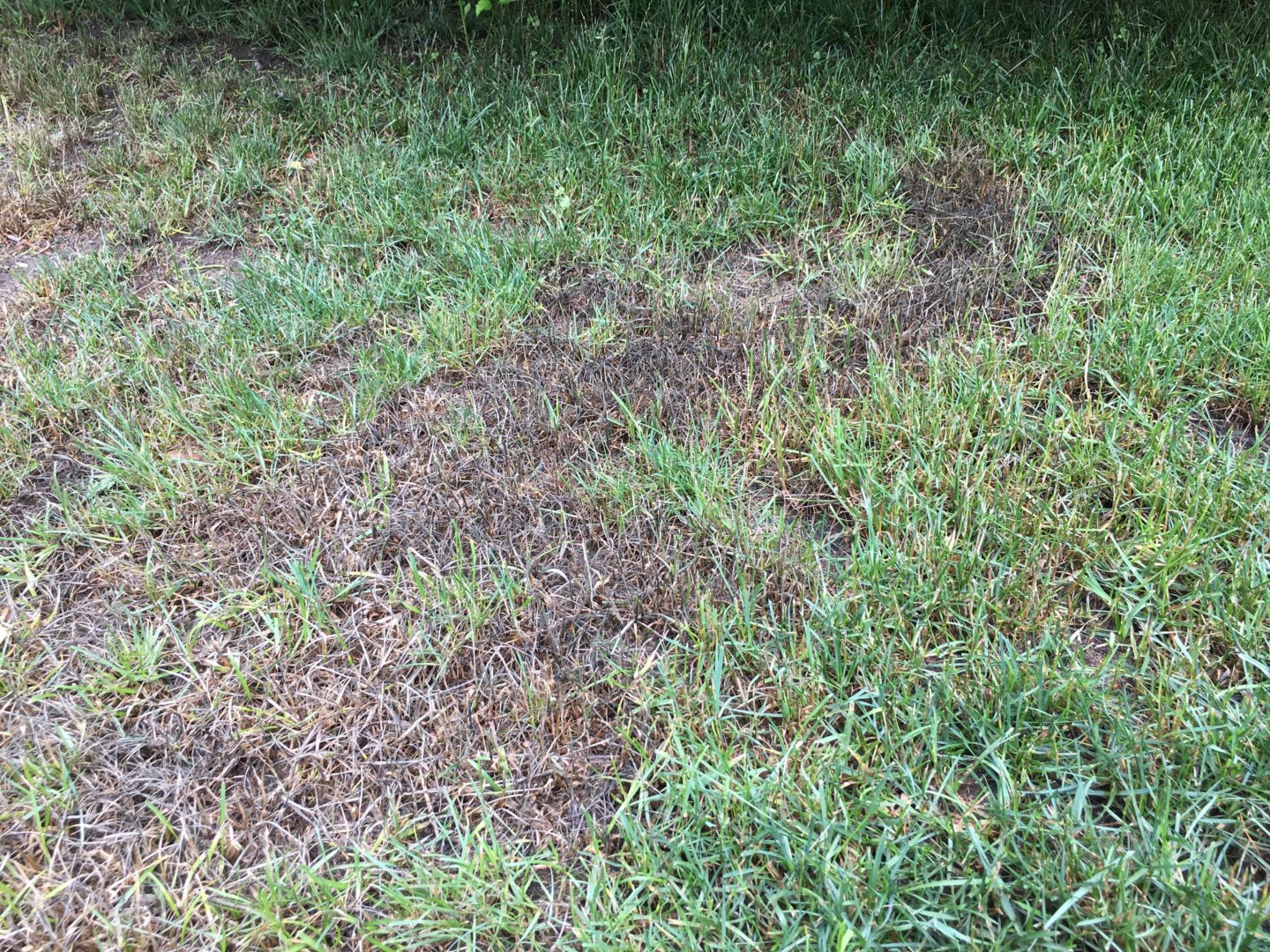
Grub damage can be severe

June is typically a transition month from spring to summer.  In terms of your grass and lawn, now is a critical time to be aware of proper mowing height.  June also signals the ability to prevent potential insect damage like grubs in NH by treating your lawn yourself or hiring a lawn care company. 

Now is the ideal time to mow your lawn at 3 inches in both shade and sunny areas.  In the sun, mowing high will help promote deeper roots which can minimize drought stress and subsequent browning.  In the shade, longer grass maximizes the reduced sun light reaching the leaf so your lawn does better long term- reducing thinning.  Try to mulch your clippings back into the lawn to improve soil organic matter and soil structure.  Removing the clippings creates an unhealthy cycle as it takes away valuable minerals, nutrients, and bio-matter.

June signals the official start of preventive grub control applications in NH which can last until September with newer materials.  Many products now exist to combat a wide variety of grubs which can cause minor to major lawn damage.  This type of damage is especially true in the spring and fall when most of these pests will be in full assault- eating your lawn from beneath.  Grubs eat the root system of your lawn from below, unlike surface insects that may chew or pierce the plant from above.

Grub control is usually divided into preventative and curative care- both require specific timing and specific materials.  Don’t just assume buying a bag of something and sprinkling it on your lawn in June or July will solve your problems.  Most curative products are harsh and usually target a larger grub while preventative care sets the stage by applying a treatment for hatching eggs or a much smaller pest.  Preventative applications generally require less material and therefore are considered more environmentally friendly.  Many preventative products have a larger time span of use and also plain work better by achieving a much higher degree of control in NH.

A short statement on Milky Spore- Don’t use it in New Hampshire or Vermont, it does not work and is a massive waste of money.  Send me the check and I will at least send you a thank you note versus the chemical company taking your money and you have nothing in return.  If you want organic insect control for grubs- Nematodes is the route you want to go, and it is actually proven to work in NH & VT- unlike milky spore that does not.  The weather is too cold and that is all I will say on this product.

Be sure to read the label on any product you buy if you plan on treating your own lawn in NH for grubs because you want to have your timing correct.  Keep that mower blade sharp and cut high- it may be tough at first but you will enjoy the long term benefits of a nicer lawn.

Lawn care companies & Japanese Beetles, Grub Control, plus Milky Spore

There are many kinds of bugs that can damage or even destroy parts of your lawn such as the grub of the Japanese beetle.  While they may be out of sight underground, their appetites for turf roots cannot be easily satisfied.  As a result, browning usually occurs all the way to large areas of dead grass in the spring or fall.  How can you save your lawn?  Can this evil beetle and its associates be stopped?  Take a deep breath as we take a closer look at this villain and his underground buddies.

Exposed White Grubs

To begin with, you must start with the environment.  Grubs live underground therefore they are considered a subsurface insect pest, as opposed to a surface one- such as a chinch bug or perhaps cutworms.  This is important because what method and material you may use to target the grubs underground is vital.  So let us move onto timing.  When can you kill them?  Well, there is curative- you have grubs and they need to die now or preventative-  you may have them or are likely to in the future so you treat ahead of time as insurance.

Before you treat anything, ask yourself a question.  Do you really need to do this?  Many lawns will tolerate minor grub infestations and do just well.  Just because you found a few in your mulch beds or garden while digging does not make for an alien invasion or epidemic!  An average lawn will tolerate grub feeding and not all grubs eat turf.  So, before you pull out the tank and flame thrower, ask for some professional advice or at least consider the multitude of choices available.

Grub control products have progressed a great deal in the last few decades in terms of effectiveness, amount of active ingredient required, ease of application, and environmental impact.  Before I proceed forget about Milky Spore, it does not work in New England and should be outlawed.  Most registrations have elapsed or are revoked which is why there is only a few on the market even though there should be NONE.  There is not a shred of scientific evidence or proof that one grub can be killed by this magical elixir in NH or VT.  While I normally do not take such a harsh stand on a topic, I simply cannot stand on the side line while people throw their hard-earned money.  Both Universities in NH & VT agree with this statement since it is at their training seminars that Milky Spore is akin to curing all of your aches and pains with just one teaspoon of “Uncle Jacks wonder tonic”.  Let us move onto more productive conversation.

There are a handful of different materials that will virtually decimate a grub population when used properly.  Many of these control products are only required in small amounts and last months because they are taken into the grass plant up through the root system.  As a result, these control products are very effective and pose a minimal risk to user and the environment.  One new product in particular does not even require a signal word (Danger/Warning/Caution) this is unheard of in the turf or agricultural industry.  Most of these products can be applied alone or blended with a fertilizer for improved results.  Some studies show that with proper irrigation, soil moisture, and fertilizer- a lawn is better protected due to the ability of the grub control material to be readily taken into the turf via the root system.

Most preventative control products can be applied from late May all the way into September in some cases.  The stage of the grub and the material chosen is imperative because not all will work at specific times or stages.  This would be like trying to stop an elephant with a broom, it just is not going to happen verses say a bulldozer- the tool being used and the timing is very important.

Nematodes are being bred and are being touted as a very effective organic if not biological control of not only Japanese but dozens of other beetle grubs.  I plan on using nematodes this year in my program and have done enough research to at least give them a try based upon my findings.  If stuff does not work, I just won’t use it- period.  Sorry, but clients do expect results.  There are lots of important things which must be done in terms of timing, watering, volume etc- but there is no denying these boys are chemical free!  I will report back in a later post the results and findings of how these treatments went later this summer.

Now is the time to research and have your lawn treated if you have had grub damage or problems in the past.  Remember, adult Japanese beetles are very difficult to control since they are strong flyers.  Good hunting.

The following link sums up the importance of timing and life cycles when selecting control products:

http://www.golfdom.com/turfgrass-maintenance/know-your-enemy?page_id=2

Lawn fertilizer- look in the mirror

Published by mrgrass2 on May 19th, 2010 - in Fertilizer

A great lawn is no accident

Fertilizers are like skittles candy, they come in a rainbow of colors and flavors.  Like oil base to acrylic paints – each kind of fertilizer is more suited to a specific purpose such as supplying nutrients to vegetables, flowers, or lawns.  Everyone has an opinion and there are lots formulations from liquid to dry to those mixed with insect or weed control materials.

A common misconception I run into is the pure amount of fertilizer required to generate a visual response in a lawn.  Said another way, if you put down 10lbs of 12-8-5 or 50lbs, what is the real difference?  Will it be greener?  When should you fertilize?  What kind of fertilizer should you use?  If you apply lots of fertilizer can you do it less often?  Do you always just throw some fertilizer around your flowers, you know- just enough- everything usually turns out just fine.  Well, while that may be ok for vegetable gardens or flower beds- the same rule will not work or produce results in your lawn.  In this area- guessing may be fun on a weekend, but it likely will not get you any real lasting results- even in the short term.  In a worst case scenario, you put down too much and damage or even kill sections of your lawn.  So what to do?

The first thing you must ask yourself is “why am I doing this”?  Do you want to really improve your lawn this year or are you just making yourself feel good because you always put something down in the spring and fall?  Second, do you care about weeds or are you just trying to green this baby up so you can sip your lemonade from the porch after work (or other adult beverage) and absorb the pure enjoyment of a green carpet?  After you answer these questions- please move onto the level 2.

Level 2- Pick your lawn level!

What lawn?:  You do not treat your lawn (why are you reading this?)

Whatever:  You put down 1 or no applications per year.  You see a bag on sale and give it a go but have no misconceptions, this is futile.

I try: You put down 1-2 treatments and usually upset yourself because deep down you care, but not enough to do more.  Your lawn is ok and actually might look nice in the spring.

Semi-Pro:  You have hired a professional company in the past and or have one doing something now.  You have tasted results and realize what potential exists but may sway from doing it yourself to hiring a company.  You understand the fundamentals of turf care and may complete 1-4 treatments yourself- even renting an aerator in the fall!

Mr. or Mrs. Green:  You have your lawn treated by a professional turf care company and expect results.  Although not a fanatic, you demand results on what you pay for- typically less weeds, crabgrass, and a velvety green carpet like dreams are made of. 

Dr. Turf:  You measure your grass height before you go to work each morning and strictly forbid children, pets, or any foreign object from walking or resting upon your luxurious turf area called your lawn.  Whatever it takes, do it.  Your lawn can be tracked by NASA and actually glows at night from the energy released.  To you my friend, I salute you.

Product selection will generally involve slow or quick release fertilizer treatments.  Slow release is more forgiving and allows you to apply more N per 1,000 square feet- the unit of measurement on how you treat grass.  Most programs will talk about N= Nitrogen because turf grass has varying requirements on how much it needs each season.  Most turf in New Hampshire or Vermont will require 3-5lbs of N per season.  This normally equates to 3 to 5 treatments per season, with 4 being the average.  Quick release, high soluble fertilizers are wonderful in the spring or fall, but after that- they risk pre-disposing your lawn to drought stress, disease, sun scald and other issues.  This includes liquid or granular formulations.  The benefit of granular treatments allows you to change the rate on site with the spreader as opposed to a liquid treatment where the rate is set like octane at the gas station.

If this post causes you to act- ask me a question, comment on the information, or call a local professional for advice like myself.  Enjoy your day.

Aeration & Seeding for Your Lawn

This is what aeration plugs look like

May is a great month to help your lawn move forward by aerating and seeding it afterward, often called overseeding.  This is normally a great time to aerate because the moisture content in the soil is high, allowing wonderful plugs to be removed by the assistance of deeper penetration by the machine.  Dry, compacted soil is very difficult to aerate even with professional grade equipment.  While you can rent small aerators, they are not the same in terms of weight, width, and tine health (length of the steel hollow spikes).  I maintain new tines on our machines that are key in breaking up the soil by removing 1″ diameter plug up to 3-4″ in depth.  Why aerate?

Benefits of Aeration.

-      Increases moisture penetration

-      Enhances oxygen exchange (important for healthy roots)

-      Reduces soil compaction (especially soils high in clay)

-      Facilitates penetration of fertilizers and other lawn products

-      Increases rate of thatch decomposition

-      Enhances root development

While power raking or dethatching is a process reserved for lawns with excessive thatch (1″) or more, you can overseed a lawn after aerating because of the holes created.  Aeration is also a form of dethatching.  Overseeding is done by using specific seed types for the lawn location and occurs by spreading the seed out over the entire lawn using a spreader.  The seed falls in the new holes and therefore makes great seed to soil contact, a necessary environment for good results.  Care needs to be taken when edging along mulch beds, walkways, and gravel driveways because the seed will grow and then becomes a weeding issue!  Some of the seed falls onto the plugs and ground which may also germinate,although this is not the main expectation.  Overseeding introduces new, superior turf into an existing lawn, especially thin and weak ones.  Overseeding can also assist in repairing damaged lawns if there are several passes to tear up the area or if topsoil is applied before applying the seed.  Again, the seed to soil contact is important.  Surprisingly, grass can grow in many soil types which you may not think possible.  The key here is picking out the correct grass type, seeding at the right time, and using the proper equipment.  May is normally ideal due to cool days and nights, yet the soil has warmed up enough to faciliate good seed germination.

Aeration & Seeding go hand in hand

Aeration & Seeding

Most lawns can benefit from annual aeration, be it in the spring or fall, while overseeding is left for improving existing turf in weak lawns or lawns needing increased density.  Of course, the next step is to get onto a good fertilizer and turf health care program to maximize the results as aftercare.  Treatments may include sea kelp to enhance the soil quality and a high calcium lime to improve seed germination/soil structure/and soil pH.

Aeration can be done as an annual process to help keep thatch in check and to prepare for overseeding.  While you can aerate and not overseed, you cannot overseed onto undisturbed ground without aerating first (unless new loam has been applied).  With such a short growing season, it really makes sense to consider one or both of these treatments if you want to move your lawn forward and receive the rewards of maximum results.  If you don’t want to do it yourself, find a local company like ours and have it done for you.  Most lawn care companies will provide a free estimate and recommend the grass varieties to be used at your location.  Good luck and may you achieve the lawn of your dreams this year!

A Short Word On Spring Seeding

Published by mrgrass2 on April 25th, 2010 - in Seeding & Overseeding

While you may be satisfied with the overall appearance of your lawn perhaps something nags at you….. those few thin areas…. those awful bare patches!  It is though you have washed your entire car and it is shining like new, but there is one patch of dirt you missed – it just plain sticks out and must be addressed.  If you are considering seeding, that is a great idea, but there are a few pit falls to this practice especially in the spring.  What might they be you ask?

Spring is normally a time to prevent crabgrass (see an earlier post) and unfortunately, seeding and crabgrass or broadleaf weed control do not mix.  Unless you avoid your bare patches or thin areas completely with a spring fertilizer and pre-emergent, your best option is not to avoid sections here and there but not to apply those materials: it is just not practical.  Seeding can be done around a lime treatment, and if you use a high calcium lime coated with an organic acid, you get a boost in germination – very nice.  In fact, seeding with a natural or regular fertilizer with a high calcium lime is even better.  Let’s explore seeding more since the stuff is anything but cheap.

Grass seed comes in many blends, mixtures, hybrid types, general use, conservation mix, shade . . .  I could go on and on folks!  Have you checked out the price at your local store for a mere 5lbs?  Not cheap!  If you are looking at annual grasses (they die at the end of the year), now those blends will be affordable because they die in the fall.  Although they have uses for quick germination and holding a new lawn from erosion, you will need a more long lasting grass to establish a lawn or fill in bare patches long term.  Most folks will opt for a ”shade” blend, or a “play” blend… perhaps “full sun” or a pre-mixed patch type mixed full of fertilizer and a paper emulsion for easy application.  My first point is all grass seeds are different and have specific rolls for specific lawn areas, be it poor soil, kids that play, full sun, shade etc.  The key to setting yourself up for success instead of failure is to determine what goes where and when in the spring.

You cannot just throw seed on the ground and expect it to grow – that would be like putting your teenager in a car for the first time and saying “well let’s go.. drive”!  Not going to happen.  Let’s break seeding down into its raw components: timing, location, grass type, watering, and germination enhancing aides (fertilizer, lime, kelp etc).

First, don’t get too anxious. Avoid seeding in April as soil temperatures are too cold for the seed to germinate and things will dry out and die or at best, you have partial germination.  Waiting until May is normally your best bet.  Don’t jump the gun.  Next, what part of the lawn are you addressing?  A shaded front, a sandy back lawn that turns into a Kansas dust bowl come July, or a nice front lawn with adequate sunshine?  Each grass cultivar (variety) requires special attention and a specific grass type depending upon your need and ability to water or fertilize to the ability of the grass to do well in certain site conditions.

Tall fescue is my absolute favorite grass because new strains make it a thinner bladed grass plus it is adapted to dry sunny conditions all the way to shade!  What a great grass!  Did I mention I love tall fescue?  I use a triple blend of tall fescue as my primary seed grass in my ETC program.  Tall fescue is great for dry sections of lawn, sunny areas, shade, and where the kids play.  The down side: it does not hold the dark green color of bluegrass and is susceptible to some diseases.  Oh well, no one is perfect right?

If you have an irrigated lawn, or a show-case front lawn with decent loam, then I recommend my friend bluegrass with some associates – fine fescue and or some perennial rye.  There are many blends for this scenario. Look for blends with 3-4 types for best insect and disease resistance… usually a blend that adds up to 100% … read the label!  You get what you pay for here and this stuff is pricey but is the Lexus of lawn grass.

Shade is best adapted to some annual grasses, bluegrass, tall fescue and his cousin fine fescue.  There are all kinds of grasses that are tolerant to shade, I emphasis tolerant because one main recurring theme is grass not growing well in shade.  Planting turf does not always solve the problem. There may be factors affecting  the area like compaction, poor air circulation, or bad pH among other things.  This is where a professional like comes into play: you may need some advice first.

You can seed into new topsoil or compost all the way to overseeding after aeration.  Generally speaking, overseeding adds turf into an existing lawn, thin areas, or small patches but it does not address bare areas.  Bare patches or sections of lawn are best left to renovations small to large where additional loam or compost is added to create a seed bed.  Yes, grass likes a nice bed in which to grow, versus sitting on bare soil where it will likely dry out and die.  Seeding like that would be a waste of time and money.

So there is my little plug on seeding your lawn this spring.  Good luck and maybe you learned a little more today about grass than you knew before?

Pre-Emergent Crabgrass Control in NH: The Coin Has Two Sides

Published by mrgrass2 on April 18th, 2010 - in Crabgrass

Baby crabgrass plant

If you have a lawn service or are preparing to treat the lawn yourself, you will likely want to consider pre-emergent crabgrass control now until mid to late May depending upon your location in NH or VT.  There are both positive and negative aspects of applying a pre-emergent in the spring depending upon the condition of your lawn, your future plans, and past issues.

The Good:

There are many types of products available and most not only reduce annual crabgrass, but also can help suppress other grassy weeds and summer annuals.  I often have a lot of clients point out rough looking grass in the early spring- saying, “See there…. my lawn is loaded with crabgrass!”  Well, crabgrass is an annual and does not even begin to germinate until late April through May (geographic soil temp) so any grass you are viewing now, is a perennial meaning it is there to stay.  Crabgrass usually germinates along the road or in bare areas that warm up first; you can see the little green sprouts with a little scouting like the one pictured above.

If your lawn has never been treated for crabgrass, depending upon the density and current condition, you may want to have a barrier put down to reduce this aggressive plant.  Left unchecked, crabgrass will thrive and take up vital lawn space- winning the battle while drawing upon space, water, and nutrients- leaving less for your desired turf grass.  Yes, like an older brother that gets most of the dessert and dinner, standard turf grass is not genetically adapt to thrive in the presence of crabgrass- a superior plant.

Crabgrass control also helps reduce summer annuals which can also be a bonus in a weak lawn.  I say suppress because many homeowner’s think crabgrass control is 100%, nothing could be further from the truth.  While a pre-emergent can help suppress the noxious plant, it breaks down over several months and will never stop growth in bare areas.  This brings me to my next point- the condition of your lawn- what is the current condition?

If you have large bare areas along the driveway, or sections completely absent of turf- I would urge a different course of action such as reseeding or perhaps some light renovation.  While most lawns can be treated and improved “as is”, there are many that simply would benefit more from the addition of loam or compost instead of a chemical barrier that will fail in weeks anyway under such stress.  My turf division offers light renovation to complete lawn installations- unlike the big National chains that do not.

The Bad:

Most crabgrass barriers, once applied, will remain in effect for about 2 to 3 months maximum depending up culture practices (mowing/watering) and the overall lawn density.  This means no seeding because most products inhibit not only crabgrass, but your seeding work as well.  Again, the best offense is a great defense- in this case, turf density.  Superior lawns take hard work; they arrive from turf building by mulching your clippings and applying fertilizer on a regular basis.

If you are unsure which course of action to take, don’t flip the coin and decide yourself, call up an expert like me and I’ll take a look.  If you live outside of my service area, send me an e-mail with a picture or call up a local lawn company with a good reputation.  Whatever you do, don’t call up the large National chains since they are in the business of applying tons of crabgrass control and cannot offer any renovation work should it be required. In addition, their sales force does not have the agronomic experience or training necessary to make an accurate diagnosis.  Enough said.

Good luck and have some fun making your lawn look great this year.  We don’t have many months to make an impact in NH, so don’t wait around- get a game plan and move forward!  Information is power.

Crabrass has a lighter green color

Researching Lawn Care Companies in NH, Part 3

Published by mrgrass2 on April 4th, 2010 - in Lawn Care Companies

In the past two posts, I have discussed a wide array of issues found in the larger lawn care companies.  I have exposed why they are so deficient in their general mode of doing business and why most consumers should be shocked at what they are really buying.  Remember, what you buy and where you spend your hard earned money makes a statement about who you are and what you believe in- be it turf care, health care, or the car you drive.  It is my belief and experience that once the potential client is enlightened- even to a few of the factoids I have discussed- the decision is easier to make.  Information is power- so let’s continue exploring another variable of this large industry called professional lawn care!

Who is making the recommendations and presenting you with your options to improve your grass?  Again, like a broken record- in most cases you will not deal with any real knowledgeable technician or manager, but a sales representative.  While this may not sound like a big deal, your contact most likely sold cars or worked in another industry and is about as qualified as I am to board the space shuttle and- well you get the point. . .   Anyone can be sold ”stuff”.  When you’re speaking with the contact person for whatever lawn care company you are receiving a bid or estimate for- ask questions!  This is your lawn we are talking about- they want the sale, you have the right to straight answers.  Are they a sales representative, a manager, a technician?  Are they the owner?  Better yet, did they create the lawn program or are they simply following “the program”?  How long have they been with the company?  There is a big difference between selling cars and selling turf programs such as the science, ever changing products/rates, ever changing state/federal regulations, and the big one- field experience.  Anyone can sell you a turf program, but what are you buying and why?  Sure there are some basics, but that is all you will get- basics from a sales representative.  I think hiring a professional lawn/turf care firm is more about wanting or needing advanced professionalism and results- otherwise, why not simply try it yourself?  Many will choose to roll the dice and risk harming their outdoor investment- the lawn.

There are a multiple reasons why you may wish to hire a lawn care company.  Save yourself time- free up your weekends or after work!  Get better results is a big one- hire someone who specializes in this line of work like a plumber or electrician- a business which requires certification and licensing!  There must be a reason to get licenses and certification- oh you bet!  Protecting our lakes, streams, and other bodies of water means you must know the distances and what types of products can and cannot be applied with specified distances such as around Lake Sunapee or Canobie Lake in NH.  Most homeowners will apply pesticides right up to the water, and in doing so would be breaking state and federal laws not to mention endangering water supplies.  Doing the right thing is just that- the right thing.  Would you be surprised to know that any homeowner can go buy materials and put them down on his or her own lawn without any licenses at all?  Would you be surprised that professional applicators must have appropriate licenses and insurance yet homeowner’s account for the largest percent of treatments in the USA- the “do it yourself” types?  What are the odds that millions are performing a correct lawn application and in doing so- complying with what is right and or legal?  That bothers me just a as a person- never mind someone who has been the industry for over two decades.  Point again, knowledge is power.

In future posts, we will discuss materials- yes the products that do the job since there has been and always will be debate from traditional to natural products.  There is a huge misunderstanding in this area with terms being thrown around like potato chips.  Hold onto your organically produced lettuce, the ride is just about to begin!

Researching Lawn Care Companies in NH, Part 1

Published by mrgrass2 on March 10th, 2010 - in Lawn Care Companies, Misc.

Essential Turf Care Program Options

This is the year you have decided to get some advice.  This is the year you want to see results and actually enjoy your front lawn as you look out that window with your cup of coffee each morning.  Your vision of brown can turn to green!  So where do you begin?

1.  Start your research online. 

Start your research online with company websites and or blogs in order to get a “flavor” for what they do, office locations, credentials such as certifications/licenses, and other important factors.  Make a short list for yourself.  What is important to you in terms of service like ease of contact and communication?  While things are always great when the going is good, can you obtain a direct e-mail address or cell phone number to ask a direct question to a manager?  Send an e-mail and see if you get a response.  How fast does the employee respond?  If you never hear back or if one is not available, you have an answer.  If you said “no” prepare to call an out of state “800 number” that is only open during “standard business hours”.

While many companies may appear alike on the surface- as you dig deeper you will find a vast difference when it comes to things like ease of contact.  Communication is key not only for just asking questions but for peace of mind.  You should feel good about having access, direct access to those who you employ like your future lawn care company.  You should feel great about supporting your local economy, especially in these economic times by hiring a local firm versus a national chain.  Who you decide to employ locally makes a direct statement on what you believe in and support.

Are there any testimonials on the website which would indicate customer satisfaction and success?  How many offices are there and who runs the show?  Information is power and the more you get a sense of who you will be dealing with, the higher your satisfaction level will ultimately be because your decision will be a sound one.

In future installments, I will discuss why you should consider experience in the field and background as vital components when it comes to hiring a turf care company.  I plan to discuss topics like how to obtain real results as it relates to product selection such as natural versus traditional programs.  Don’t wait, start researching today!


March Madness: Help Your Lawn Wake Up

Published by mrgrass2 on March 4th, 2010 - in Cultural Practices

The growing season is very short in NH & VT, but with a few basic observations now- your lawn does not have to start off in the wrong direction.  On the contrary, with a few simple steps, your lawn can become a source of great enjoyment on a daily basis as you arrive home from work, bbq dinner, or just sit on the porch taking in the green carpet.  Statistics show that green spaces such as turf and a well landscaped yard reduces blood pressure and improves overall mental health.  So where to begin?

Back to the title of our little post today, March madness.  March is a great time to take a walk around the property and inspect for debris that may have fallen off your trees- like needles, leaves, branches, or perhaps entire trees (call me).  Do you have any plow damage along the driveway, walkway, or main road?  If so, plan on either reseeding these areas or replace the chunks of sod if they are not in little pieces.  Most folks will reseed early instead of waiting until late April or May when the soil is warm enough.  Why?  While the air temperature may be nice, the ground will still remain very cold- not helping out your seeding effort at all.  Go ahead and shop for your seed, or call me- but hold off on the task itself.

Give your turf a jump start- go rake up gravel, debris, and matted turf to encourage air and light to help awaken your slumbering blanket of love.  If you see pink patches- you probably have snow mold which makes raking that much more important.  The sooner your lawn wakes up, the sooner it can start manufacturing food and outgrow the setbacks of winter.  The longer your lawn remains matted, wet, or covered with leaves and debris- the more likely you will not have grass or at least less come May or June.  Sometimes basic things like raking can be the most illusive yet helpful.  Don’t contemplate- go out and rake!

© Copyright 2009-2012 Chippers, Inc. All Rights Reserved.