Posts Tagged ‘brown turf’

July & August can bring out the worst in a home lawn

Classic mid summer crabgrass outbreak

Midsummer weather can put even a great looking lawn into a slow dive of despair without careful attention.  As the heat kicks into high gear, soil temperatures reach their smoking point and crabgrass seeds begin germinating in earnest, popping like corn in a microwave.  Limey green crabgrass plants appear virtually overnight exposing vulnerable areas along driveways, patios, walkways, mailboxes among others.  Where did they come from?  How can they grow so fast?  Ah, the games have just begun!

If you have not watered and your lawn is cut short, now is when your thin lawn becomes choked out with crabgrass plants the size of small cars.  During hot, humid weather, cool season grasses will stop growing, sitting idle while crabgrass seemingly grows an inch an hour, basking in the searing July heat.  A weak or thin lawn, or those lacking a pre-emergent crabgrass barrier, are now at high risk for a crabgrass invasion that will only cease when school reopens.  While post-emergent sprays do exist, spraying at this stage is like using a garden hose on a house fire: it’s best just to let nature take its course.  Measures should be taken in the fall such as aeration, overseeding, lime, and turf thickening fertilizers to help prepare the lawn for the following spring.  A healthy lawn resists this invasion, and although areas may see some crabgrass, it will not be to the point where one could harvest the greenery for salads.

Damaged lawn

A casual glance toward the interior of your lawn may reveal disturbing patches and blotches of varying sizes and colors ranging from brown to white.  How can this be?  What went wrong?  Like a good CSI episode, it is time for the facts to speak and rule out the guessing.  These issues generally fall under environmental stress such as heat, sun scald, or some other non-pathogenic source.  Ruling out diseases can be very tricky depending upon the weather, timing, and location of injury.  This summer has seen a significant upswing in disease-related damage ranging from pits and scars, to unusual patches.  Preventative measures can be taken to help clean up your lawn with either traditional or organic treatments.  Insects are perhaps the easiest to detect given their predicable nature and timing during the season.  Now is a perfect time to treat for grubs, sod webworm, and chinch bugs using either organic or traditional materials.

Doing some simple things properly for your lawn during the next 6 weeks can reduce unsettling issues arising from disease, insects, and environmental stress.  Summer is generally not the best time to spray for difficult to control broadleaf weeds like ground ivy and violets since high heat and low soil moisture content reduce product effectiveness.    If you think you have an invasion at your house, get it checked out and maybe there is a solution to either stop the problem or slow the damage.  Don’t let your lawn scare the neighborhood children – plan ahead and keep it clean and green!

Chinch bugs, when a brown lawn goes bad

Chinch bugs are under rated and a delightfully evil little lawn pest.  They love hot weather and can devastate a lawn if left unchecked in mere days to weeks.  Don’t think your are in the clear if you live out in the woods, these pests will find your lawn and eat it while you sleep.  They are small, they are shy and hide down in the thatch layer where you don’t see them.  Chinch bugs vary in color but the adults have an unmistakable white diamond on their backs.

These tiny little fellows have kids that range in color from orange, to gray, to black before reaching the slim classic adult with the diamond back.  They are about 1/8″ long and run fast when you uncover their hiding places.  A trained eye can easily spot them but unless you are down at ground level forget about it, these guys will party until your lawn is dead and gone.  The funny thing about chinch bugs is they get about two generations in NH and VT.  Left to their own evil plans, chinch bugs populations will build over time- especially in dry weather.  Since the adults overwinter and hide for the following year- the population will continue to expand and move further into your lawn.  In other words, chinch bugs do not die over the winter, they hide and wait for warmer weather like many of us!

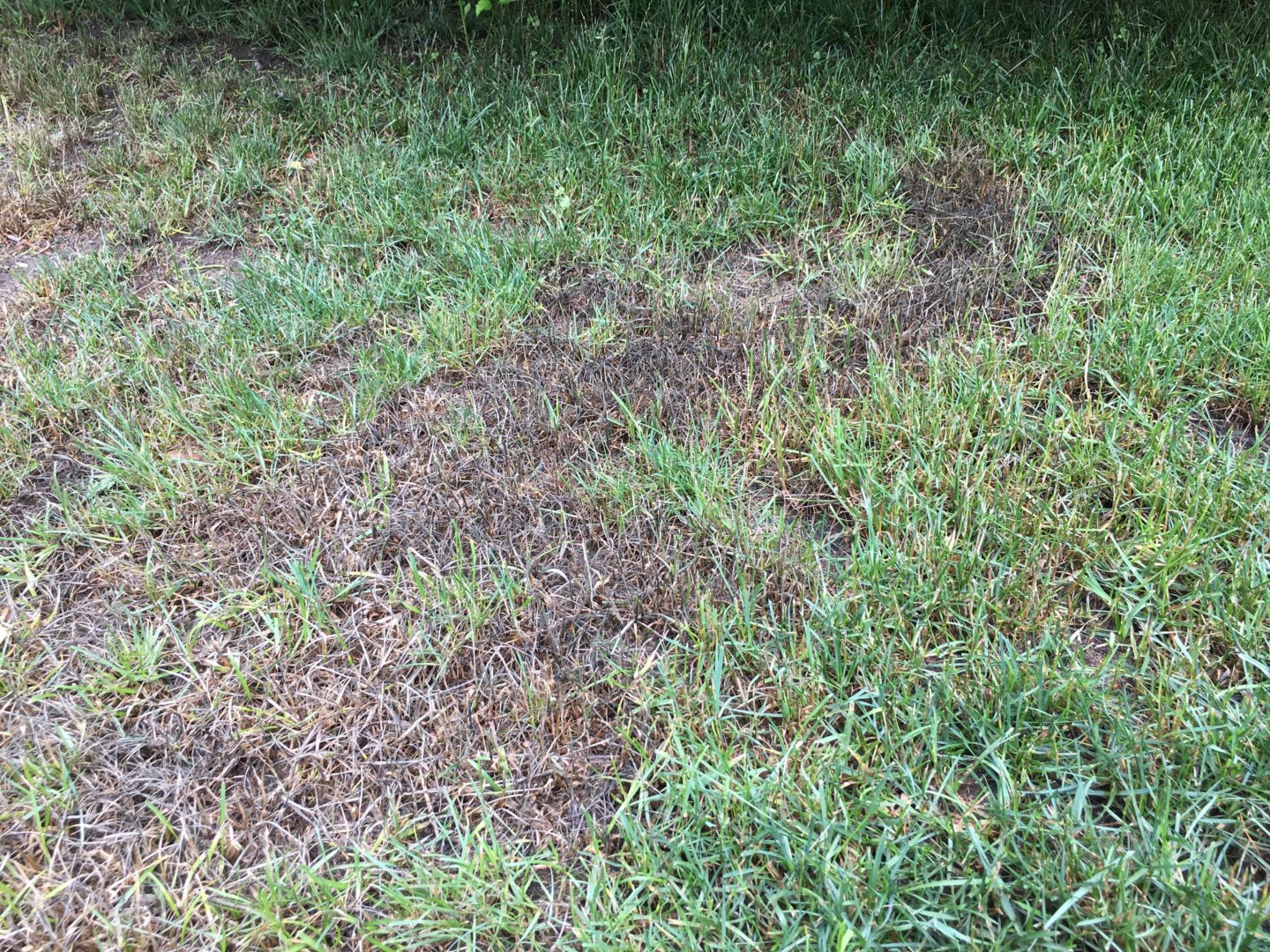
I recently visited a lawn which pictures I have enclosed in this post.  I have not seen this many chinch bugs since the late 90′s!  Oh my word, there were so many, they were climbing up the garage door and foundation.  Can you say science fiction?  Not in this case- this is real.  If you view these pictures- the lawn has a grey tint to it versus a brown or tan.  While most lawns will only suffer blotches or patches, a heavy infestation will cause extreme thinning and the unmistakable look of death- grey.  This lawn has suffered massive damage and most of the turf will not recover especially with heat and drought stress.  We treated the lawn to clean up these villans today mostly to save the front lawn and stop the population explosion underway.

If you have any doubt, have a professional check it out.  This homeowner went to a local garden center and a few other “experts” and no one could determine the identity of this bug.  This is why licensed, educated, field experienced veterans like myself are truly of value and set the bar of those in the industry by merit and deed.  Don’t let a brown lawn stay brown, make sure it is checked.

High Heat and Brown Grass

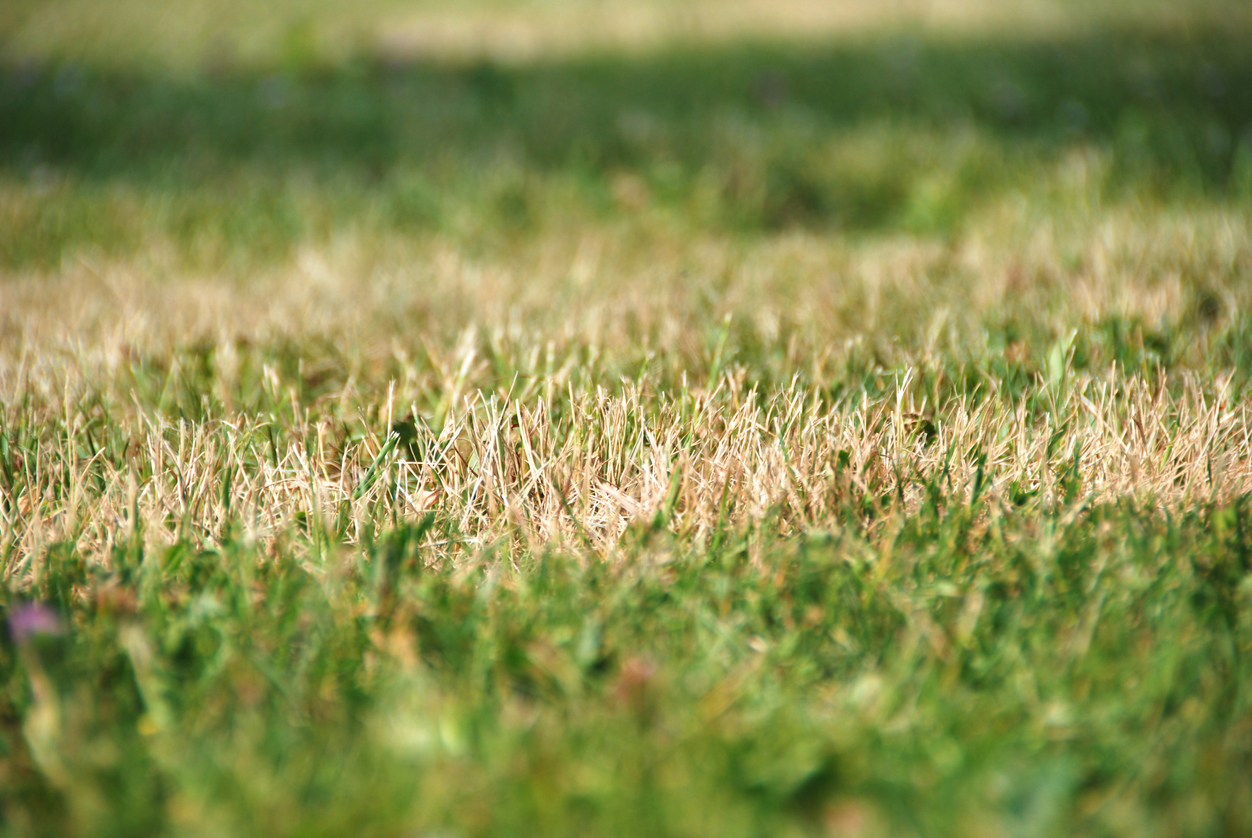
High heat and a lack off rainfall is double trouble when it comes to your cool season lawn- whether in NH or VT.  Brown grass results within days if not weeks after prolonged heat and an absence of rainfall.  What is a homeowner to do?

At this time of year, most action would be preventative such as proper cutting height (3”), lime, slow release fertilizer, mulched clippings to enhance organic matter, not mowing during the heat of the day, and having over seeded with a drought tolerant turf.  In terms of no rainfall, unless you have an irrigation system setup properly or a very shaded lot- browning is as inevitable as bacon in skillet on Sunday morning.  Hmm, you can just hear the sizzle and smell the lawn drying out to a golden brown!

On a serious note, its not the browning of your lawn that is a huge thing, but what might eat it while brown.  You would never know of an attack because green turning to brown might get your attention while outside.  What about brown staying brown?  Nothing can indicate a problem- no color change.  Now is the time to monitor for chinch bug, grub, or sod webworm activity either yourself or by hiring a professional licensed lawn care company. 

In terms of watering, anything is helpful- but don’t expect that magical green you would see in the spring or fall.  Providing an inch or more of water may not even be allowed if there is a ban like many towns are now experiencing here in NH.  Since most grass needs about an inch per week, anything else helps to keep the dormant turf alive as it remains in a hibernation state.  High heat will brown out and cause all kinds of blotches and spots in a treated or non-treated lawn setting- it is plain just too hot for cool season grass when the mercury rises above 85 to 90.  High heat can cause white blotches on the leaf blade to creating drought stress as dull blue or purple sections.  Further stress results in a tan or light brown lawn as the plant shuts down to preserve itself.  Remember, grass blades are 99% water, so no water- no grass to grow!

 Now is not the time to apply liquid fertilizer or herbicides- the result can be a disaster resulting in what I call “corner to corner grey or brown turf”.  A trained eye can spot this kind of chemical induced stress.  High soluble fertilizers place undue stress on a lawn already on the edge.  Mowing during the heat of the day is like lying on your driveway at noon- hot and unpleasant.  Any remaining moisture is quickly lost through the fresh cuts as the lawn literally wilts in hours- sometimes causing massive browning.  Stressed turf is highly susceptible to mower tracks from the weight of a tractor.  This is also true of lawn care companies that use perma-greens and other powered equipment to apply fertilizer, lime, or herbicides- the pure weight causes tire tracks and the resulting brown lines!  A light touch using smaller spreaders helps to minimize this issue.

In short, high summer heat is not customary in NH or VT, but when it does occur- be sure to watch out for insect damage, water if you can- what you can, don’t mow if you don’t have to- especially during 11am to 3pm, and cut high 3” to 3.5”.  Don’t feel obligated to mow when not mowing is really the best course of action.

Take a vacation and have some fun- but make sure you take care of your investment!

Lawn care companies & Japanese Beetles, Grub Control, plus Milky Spore

There are many kinds of bugs that can damage or even destroy parts of your lawn such as the grub of the Japanese beetle.  While they may be out of sight underground, their appetites for turf roots cannot be easily satisfied.  As a result, browning usually occurs all the way to large areas of dead grass in the spring or fall.  How can you save your lawn?  Can this evil beetle and its associates be stopped?  Take a deep breath as we take a closer look at this villain and his underground buddies.

Exposed White Grubs

To begin with, you must start with the environment.  Grubs live underground therefore they are considered a subsurface insect pest, as opposed to a surface one- such as a chinch bug or perhaps cutworms.  This is important because what method and material you may use to target the grubs underground is vital.  So let us move onto timing.  When can you kill them?  Well, there is curative- you have grubs and they need to die now or preventative-  you may have them or are likely to in the future so you treat ahead of time as insurance.

Before you treat anything, ask yourself a question.  Do you really need to do this?  Many lawns will tolerate minor grub infestations and do just well.  Just because you found a few in your mulch beds or garden while digging does not make for an alien invasion or epidemic!  An average lawn will tolerate grub feeding and not all grubs eat turf.  So, before you pull out the tank and flame thrower, ask for some professional advice or at least consider the multitude of choices available.

Grub control products have progressed a great deal in the last few decades in terms of effectiveness, amount of active ingredient required, ease of application, and environmental impact.  Before I proceed forget about Milky Spore, it does not work in New England and should be outlawed.  Most registrations have elapsed or are revoked which is why there is only a few on the market even though there should be NONE.  There is not a shred of scientific evidence or proof that one grub can be killed by this magical elixir in NH or VT.  While I normally do not take such a harsh stand on a topic, I simply cannot stand on the side line while people throw their hard-earned money.  Both Universities in NH & VT agree with this statement since it is at their training seminars that Milky Spore is akin to curing all of your aches and pains with just one teaspoon of “Uncle Jacks wonder tonic”.  Let us move onto more productive conversation.

There are a handful of different materials that will virtually decimate a grub population when used properly.  Many of these control products are only required in small amounts and last months because they are taken into the grass plant up through the root system.  As a result, these control products are very effective and pose a minimal risk to user and the environment.  One new product in particular does not even require a signal word (Danger/Warning/Caution) this is unheard of in the turf or agricultural industry.  Most of these products can be applied alone or blended with a fertilizer for improved results.  Some studies show that with proper irrigation, soil moisture, and fertilizer- a lawn is better protected due to the ability of the grub control material to be readily taken into the turf via the root system.

Most preventative control products can be applied from late May all the way into September in some cases.  The stage of the grub and the material chosen is imperative because not all will work at specific times or stages.  This would be like trying to stop an elephant with a broom, it just is not going to happen verses say a bulldozer- the tool being used and the timing is very important.

Nematodes are being bred and are being touted as a very effective organic if not biological control of not only Japanese but dozens of other beetle grubs.  I plan on using nematodes this year in my program and have done enough research to at least give them a try based upon my findings.  If stuff does not work, I just won’t use it- period.  Sorry, but clients do expect results.  There are lots of important things which must be done in terms of timing, watering, volume etc- but there is no denying these boys are chemical free!  I will report back in a later post the results and findings of how these treatments went later this summer.

Now is the time to research and have your lawn treated if you have had grub damage or problems in the past.  Remember, adult Japanese beetles are very difficult to control since they are strong flyers.  Good hunting.

The following link sums up the importance of timing and life cycles when selecting control products:

http://www.golfdom.com/turfgrass-maintenance/know-your-enemy?page_id=2

© Copyright 2009-2012 Chippers, Inc. All Rights Reserved.