Archive for the ‘Broadleaf Weeds’ Category

A look back at the 2012 lawn care season.

There is little disputing the 2012 growing season was a record breaker in more than one area.  Extreme heat and corresponding drought caused widespread damage to even well cared for lawns.  The effect of these weather phenomena then led to massive explosions of pests like grubs and chinch bugs.  Even with November fast approaching, the pest issues will spill over into the spring of 2013, and if left untreated, will continue to cause turf damage.  There is little that can be done for physical lawn repairs at this point in the growing season like bringing in new loam or trying to establish a lawn through seeding.  However, beneficial turf treatments applied now like potassium, lime, compost tea, sea kelp, and slow release fertilizer can help both a damaged and healthy lawn.  Lawn repairs ranging from small to full renovations should be explored now or at least during the winter months as landscapers and lawn care companies will be overwhelmed this spring by sheer volume of repairs necessary never mind pest treatments.  Timing could not be more critical in terms of seeding and treating for damaging turf and ornamental pests than the spring of 2013.  Even if the weather pattern returns to a more “normal” or stable pattern, the repercussions of this season’s heat and drought will continue into 2013.  Although brown grass in October can be a result of past drought and exposure to dry weather, it can also spell bug troubles in the surrounding lawn as grubs vigorously eat fast growing root systems.

Don't wait until the spring to make your lawn plans

I am seeing grubs in record setting numbers and on lawns which have never had a past issue.  While a curative treatment is only a short term fix, a preventative treatment in 2013 may well be in order for more lawns than previously expected.  I do not normally endorse the use of materials to preventatively protect against grubs, which in a normal year are rarely a huge issue unless past history indicates a problem.  However, I will be firmly endorsing both curative and preventative grub control on a case-by-case basis for 2013 because of the high risk factors recently experienced in New England.  Furthermore, another mild winter would further enhance tick populations in 2013 in addition to hundreds of other outdoor pests.  Make a note on your calendar to explore the potential health issues this winter and make plans, if deemed appropriate after speaking to professionals in the industry, such as Chippers.

On the bright side, the recent rain and cooler weather in combination with fall lawn treatments are helping damaged and weak lawns recover to the maximum degree possible before winter.  Don’t dismiss potassium, compost tea, and aeration after the harsh growing season we experienced this past year.  All of these treatments can be done well into November in most of New England so long as the ground does not freeze.

White grubs are eating your lawn without you knowing it!

In closing, don’t forget the millions of crabgrass seeds which were deposited in record numbers along driveways, patios, and walkways because of drought or insect damaged lawns.  Although a thick, healthy lawn is your best defense against crabgrass, some areas will not be up to the task without additional help of a preventative crabgrass barrier in the spring of 2013.  Timing will be key and a lot of good can be done in an eight week period next spring, so don’t file your lawn contract when it arrives this winter, review it carefully and setup a proactive plan to both protect and perhaps restore your home lawn for the investment it truly is!


Broadleaf weed problems?


As Labor Day approaches, you are likely forced to think about school resuming and the sad state of affairs with your lawn.  If you have an average lawn in New Hampshire or Vermont, you are likely going to find fat broadleaf weeds like plantain, dandelions, and clover among a host of other weedy villains.  Let us not forget to give tribute to the massive crop of crabgrass which has now grown into your driveway, patio, and walkway cracks!  You my friend have lawn problems!  What to do?  There must be something that can be done!

If you attempted to treat for weeds this summer, your efforts were most likely in vain due to high temperatures and dry conditions.  Broadleaf weeds are best reduced when they are actively growing which usually occurs with cool fall or spring weather when soil moisture is adequate.  Any summer spraying usually just causes the surrounding turf to brown under the stress and the weed itself might look a worse for wear but does not die.  This year brought such unusually hot and dry weather, attempting to keep a lawn free of weeds and especially crabgrass seemed like spraying a house on fire with a garden house.  While proper mowing does help, irrigation became vital if your well supported the flow or your town did not put a watering ban in effect.  Brown grass caused the soil to heat up quickly where dormant crabgrass and annual weed seeds popped up and grew overnight, basking in the hot noon sun.  That is the past and explains why your lawn may look the way it does today, even with professional care.

Moving forward, you have two main options, renovate and repair damaged lawn areas to regain lost lawn or go after the weeds once we get cooler, wetter weather.  My advice to most folks is to aerate and seed in the fall and repair any lawn damage without the pressure of crabgrass and annual weeds, that are now dying (something about them dying in the fall).  With reduced competition, fall becomes the best time to overseed and aerate a lawn after a brutal New England growing season.  Go after the weeds next spring when seeding is less effective and crabgrass lurks, just waiting to over run your best efforts in lawn repair.  There is little time now to spray for weeds and seed, given most weed control products have a one month waiting period before seeding is recommended. My advice for the average home owner is to get as much grass back now and then deal with the weeds next spring.  Try improving the soil quality by adding sea kelp or compost tea to get an edge next spring.  The next few months are critical and should be taken full advantage of if you really want to make a difference in your home lawn; not only this fall but to set the stage for the entire growing season of 2013!

Your brown lawn may have more than a color problem

High heat and lack of rainfall has NH & VT lawns turning brown


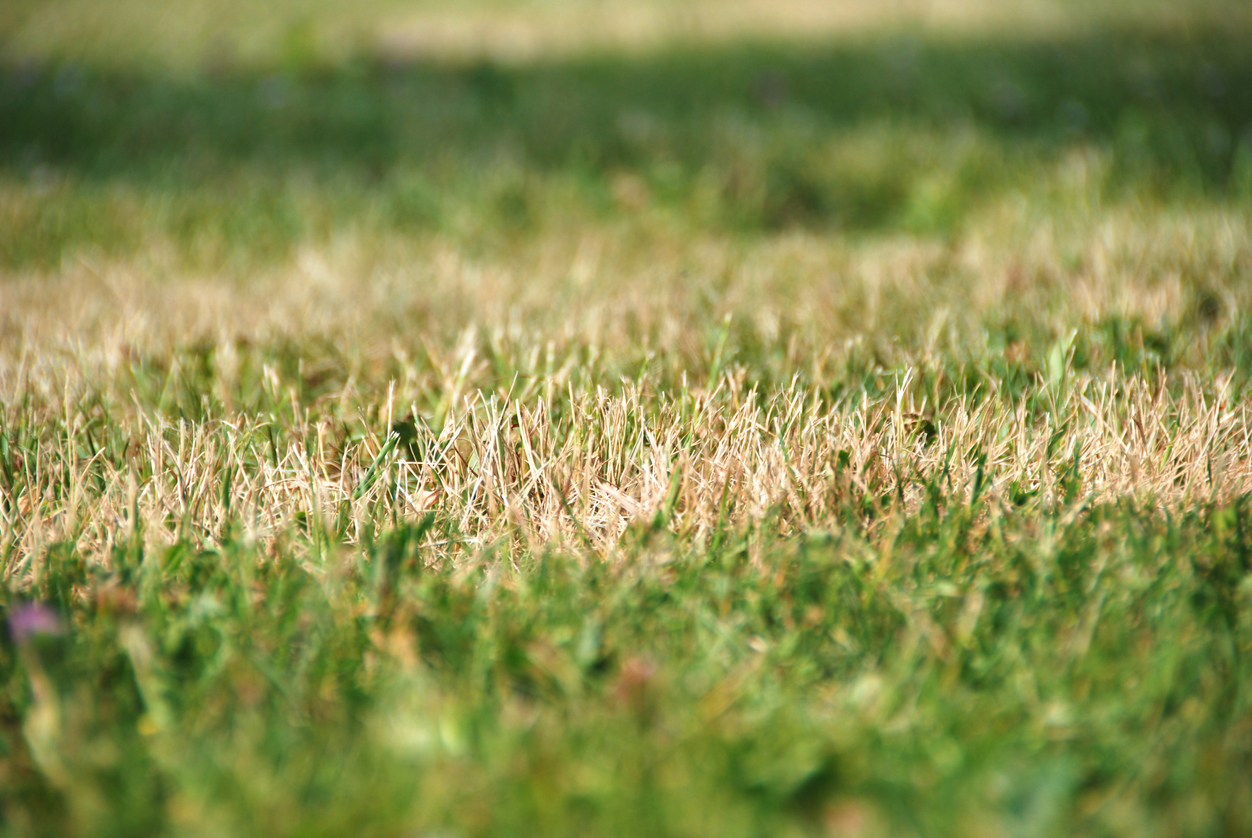
The summer of 2012 is shaping up to be one of record heat, sun, warmth, and drought in many areas across the USA.  While this is fabulous vacation weather for the beach and outdoor activities, your lawn may have gone brown months ago depending upon your location.  In New England, we are experiencing dry weather not felt since the 1950’s.  I don’t imagine Elvis would be pleased to have a brown lawn upon his return home from touring.

At any rate, severe lack of moisture can create other problems beside the straw colored grass you see below your feet.  Extended dry periods cause the soil temperature to dramatically rise, which in turn causes crabgrass and other noxious annual weeds to germinate in earnest.  While your cool weather-loving turf is asleep trying to just survive, weeds can pop up and seemingly grow inches a day.  This is especially true of crabgrass, even with a preventative treatment applied in the spring since the product’s life span only lasts into late July or early August in NH or VT.  Super heated soil creates an ideal growing environment for crabgrass, even in the best cared for lawns.  A light touch is the best course of action until September arrives and restoration efforts can begin.

A more serious side to drought is the fact it attracts all kinds of heat- loving insects like Japanese beetles, chinch bugs and sod webworm to name just a few.  Damage can be occurring right under your feet without a hint of the battle raging in the soil or on the hot brown surface of your beloved lawn.  Left unchecked, fall rainfall comes and your lawn never recovers, which might be attributed to small grubs feeding from late summer right into fall.

Even those grassy areas lucky enough to have irrigation or some shade are not immune to the heat and humidity.  I have seen plenty of brown patch disease rising up overnight due to humidity and wet grass, with the resulting damage visible the next morning.  Mowing grass already in drought conditions or during the heat of the day is like pushing a friend over a cliff with the flu, just plain mean.  The best advice in a hot summer with a significant lack of rainfall is to stay off the lawn if possible, watch and treat for insects as necessary based upon population levels, and irrigate if possible in the morning – even if only for a short period of time.  Even a little water is better than nothing when it comes to keeping the dormant growing point of your grass alive.  Like an IV in a sick patient in the hospital, any moisture applied is better than none in an absence of rainfall.

Any fertilizer used should be at a low rate, slow release, and generally granular in nature.  With autumn only a month away, we are at the top of the roller coaster and things should slowly begin to improve as August fades into September.  If your lawn has taken a hit like many have, plan now to have restoration services lined up in order to take advantage of the best growing time of year for grass – fall!  Services like core aeration, overseeding, lime, compost tea, and organic or natural fertilizers can bring a lawn back to life in preparation for 2013.

Enjoy the heat now because your lawn sure hates it, at least in New England.

Weed Control: Pre-emergent vs. Post-emergent

Published by mrgrass2 on May 14th, 2012 - in Broadleaf Weeds, Lawn Care Companies


I have lots of folks asking the difference between treatments that claim control over annual broadleaf weeds, or pre-emergent weeds like spurge, vs. post-emergent weeds such as dandelions.  While this is often a very confusing distinction, a brief explanation will clear things up and differentiate between the two types of weed control.

Annual broadleaf weeds germinate beginning in late April and continue throughout the summer.  The early season crabgrass suppression treatment not only inhibits crabgrass, but these annual broadleaf weeds as well.  Therefore, these weeds don’t even germinate because of this first treatment in many lawn programs.  However, this type of treatment will not control existing weeds like dandelions or clover.  A subsequent treatment which targets these perennial or biennial broadleaf weeds works completely different by attacking the plants you see in your lawn right now.  This is done by contact with the leaf surface and by absorption into the root system.

Although there are some annual broadleaf weeds which will germinate later and not be controlled by the first treatment in April or May, subsequent weed treatments in a post-emergent setting will address those villains.  Another option to naturally reduce both annual and perennial/biennial broadleaf weeds involves turf building by adding compost tea, kelp, annual aeration/overseeding, lime, as well as natural or organic fertilizer.  A healthy lawn that is thick and growing will naturally crowd out a huge amount of weeds over time without the need for broadleaf weed control treatments.  However, many folks like to speed the process up by having a few select weed reduction treatments followed up by a conversion to natural treatments afterward.

So, if you are confused about pre-emergent weed control versus post-emergent weed control, I hope you feel a little better after reading this short blog post!  Have a great spring and don’t fear, “Mrgrass” is always near!

Spring in NH & VT, take action on your home lawn!

Spring is a time for action

Spring is a time for action

Maybe this is the year you have decided to take action and are simply not willing to accept the same old lawn you had in 2011.  If this is the year you have decided to act, then I have good news!  Your turf can look better, and with the right game plan, will provide enjoyment throughout the summer with visible monthly progress.  After all, why suffer through another year when this type of property improvement is generally fairly easy with predicable results?  The key to success is to just say yes, seek out professional help and get a game plan.  Once spring arrives, everyone gets busy and before long it’s July 4th or later!  Don’t let this spring slip away when so much good can be done to enhance your own lawn and property.

Spring is perhaps the most important time of the year to get your lawn on the road to improvement.  One big reason is looking into the future; do you want to enjoy the benefits sooner or later?  Later would be beginning in the fall, while sooner would be spring.  A damaged or thin lawn may require aggressive steps to help reclaim lost grass such as seeding, aerating, overseeding, or even crabgrass suppression to help get the ball rolling.  Waiting until fall gives the advantage to the enemy, like crabgrass, annual weeds, or even insects like grubs.  An idle lawn will remain just that, the same or worse as the year before without corrective measures.  Spring provides ideal grass growing weather due to moderate temperatures and ample moisture.  Cool-season grasses flourish in spring time weather like an athlete training for a race.  Not only must your lawn do well, it must do great in order to compete for light, water, space, and air in your home or commercial lawn.  This is competition pure and simple.

Just doing something will not do the trick.  Too much of a good thing can be bad as or worse than doing nothing at all.  The key is applying the right ingredients at the right time.  Picture in your mind making yeast bread with 5 times as much yeast as the recipe calls for- disaster!  Imagine this same concept when caring for a home lawn.  Some will put down ½ the required amount while others will easily double or triple the amount required.  Regardless of any burning or striping, the end results will be poor!  Take the guess work out of the equation and consider a professional to care for your property this season and spend your free time doing something fun instead!  This is the year to take action so you can feel good and your lawn will look great as well.

Do It Yourself versus The Turf Care Professional Reason #2: Time and Money

Your free time is worth a lot!

There is an old saying “time is money” which refers to how valuable time is to everyone.  One might say that weekend time, or time away from work might be considered the most valuable, as it relates to family, friends, and recreation.  Time is a premium commodity and is both highly prized and savored by Americans after an exhausting work week.

This exact philosophy applies to caring for your home lawn, regardless of its size.  Many people hire a company to mow their lawn because it saves them hours per week that they can spend doing more enjoyable activities.  The same correlation can be made to applying lawns treatments to keep your lawn healthy and green.  Applying a lawn treatment might seem easy on the surface.  However, doing the treatments right and using the correct products can pose a serious dilemma to the average home owner.  Let’s consider the real cost of time and money involved with these types of activities.

First, you need to have a spray rig or a dry spreader to apply lawn materials.  Most spreaders available at the hardware store are sweet little things, not really setup for ease of use.  Consider hard plastic tires versus air inflated commercial grade tires while walking an acre, no comparison!  Now you have invested in a $60 throw away lawn spreader with no real serviceable parts.  Now comes the hard part, what are you going to put down on your lawn?

A toy spreader for home use, very sweet

You now have to shop for the actual goodies, the fertilizer or lime; perhaps even blended with some other items to knock back weeds, bugs, or minimize crabgrass growth.  There are lots of commercial formulations made by large companies trying to simplify this difficult task by labeling the times of year as “Steps” for instance.  This is where Step One would be in the spring and Four or Five would be in the fall.  While the essence of this seems logical, what is or is not going on in your lawn certainly may not reflect your real lawn care needs at a given time during the growing season.  What’s the big deal you might say?

Well, if you are treating for chinch bugs but really have a grub problem that is a real problem.  You have now applied a pesticide unnecessarily and have not solved the issue at hand.  Don’t forget, these products are not cheap; you can lay down a quick $100 to treat a quarter of an acre without even looking at the receipt.  Don’t forget about the damage still being done or the cost of a lawn renovation.  Diseases and insects are real threats and are not easy to diagnosis without some field experience and education. 

Back to the time element; the time involved shopping, carrying the bags back home, and actual application can easily turn into half a day barring any confusion, weather issues, or other time consuming delays.  Most lawn care products also have rates and ranges, but that assumes you know what you’re treating. The TV ads make treating your own lawn seem easy, like grilling up a burger on a Saturday night, but this is oversimplified.

Best case scenario, you bought everything you need – and used up most of your prized Saturday morning and into early afternoon putting down a weed and feed plus lime, plus crabgrass inhibitor.  Let’s assume you did the job right.  How does this really break down in terms of time and money spent?  Most products you find at the hardware store are either setup for a 5,000 or 15,000 sq.ft. yard. A recent online search brought up the following data to fertilize a lawn and treat it for both broadleaf weeds and crabgrass:

I will use a common lawn size of 8,000 sq.ft. Which means you will need two bags of the aforementioned product @$65 each, now you have to store a partial bag for use next spring.  Hmmm, wonder if it will be useable next year?  $130

1hr shopping for fertilizer and bringing it home   $25

1hr for application/cleanup                                $25

Approximate total cost of $180, excluding your spreader.  Remember, I said the job was done correctly, what if it was not?  Oh my.

A professionally licensed and insured applicator in VT or NH could do the same treatment in 15-20 minutes and charge you between $60 and $95 depending upon your location and actual materials/rates used, which do vary.  The old saying, “you get what you pay for” surely does have a legitimate basis.

If you want the job done right, would like more free time, and still want to enjoy your landscape, perhaps this is the year to explore alternatives to doing the work yourself.  The math sure looks good, what about your lawn?!

July & August can bring out the worst in a home lawn

Classic mid summer crabgrass outbreak

Midsummer weather can put even a great looking lawn into a slow dive of despair without careful attention.  As the heat kicks into high gear, soil temperatures reach their smoking point and crabgrass seeds begin germinating in earnest, popping like corn in a microwave.  Limey green crabgrass plants appear virtually overnight exposing vulnerable areas along driveways, patios, walkways, mailboxes among others.  Where did they come from?  How can they grow so fast?  Ah, the games have just begun!

If you have not watered and your lawn is cut short, now is when your thin lawn becomes choked out with crabgrass plants the size of small cars.  During hot, humid weather, cool season grasses will stop growing, sitting idle while crabgrass seemingly grows an inch an hour, basking in the searing July heat.  A weak or thin lawn, or those lacking a pre-emergent crabgrass barrier, are now at high risk for a crabgrass invasion that will only cease when school reopens.  While post-emergent sprays do exist, spraying at this stage is like using a garden hose on a house fire: it’s best just to let nature take its course.  Measures should be taken in the fall such as aeration, overseeding, lime, and turf thickening fertilizers to help prepare the lawn for the following spring.  A healthy lawn resists this invasion, and although areas may see some crabgrass, it will not be to the point where one could harvest the greenery for salads.

Damaged lawn

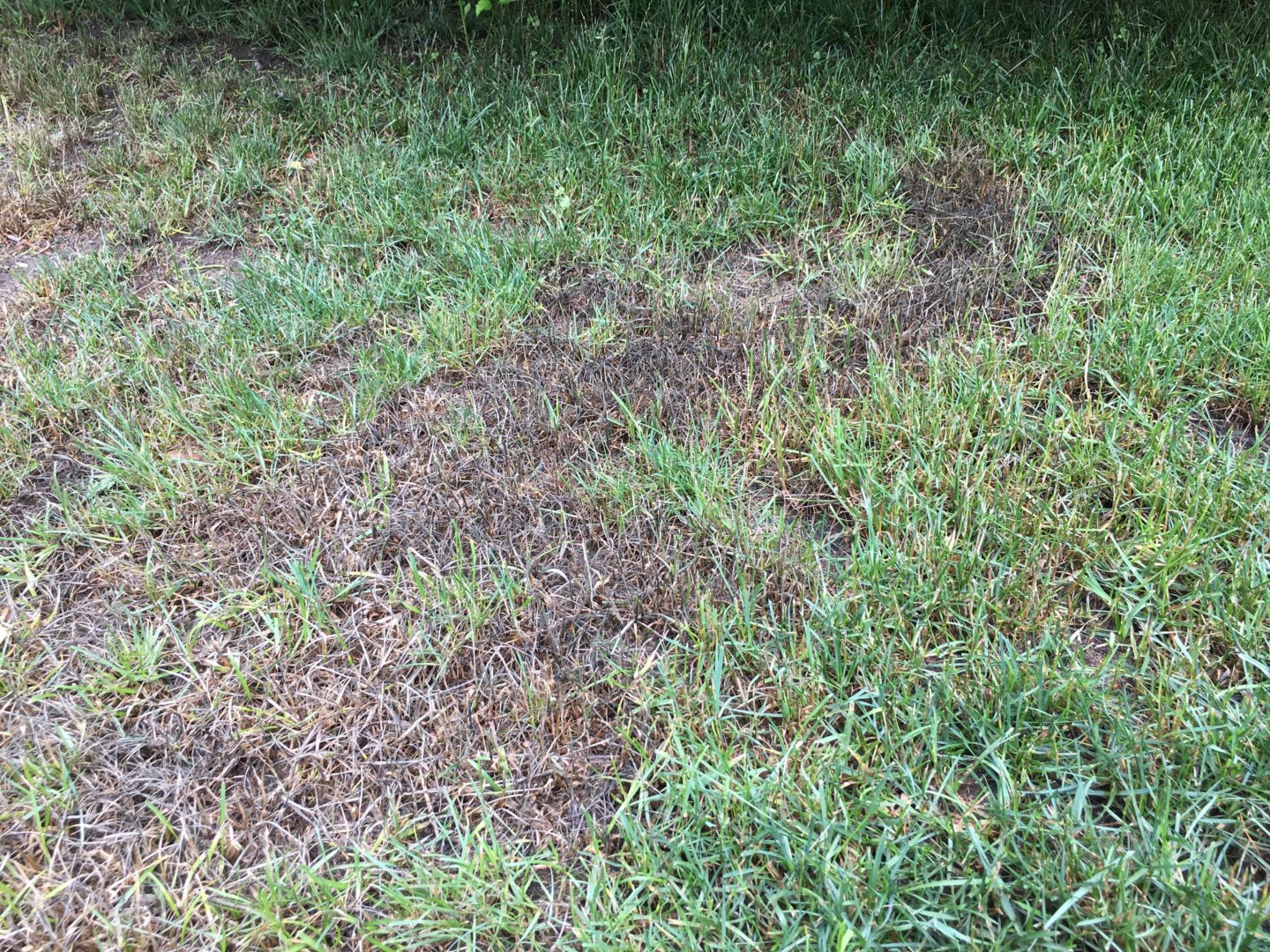
A casual glance toward the interior of your lawn may reveal disturbing patches and blotches of varying sizes and colors ranging from brown to white.  How can this be?  What went wrong?  Like a good CSI episode, it is time for the facts to speak and rule out the guessing.  These issues generally fall under environmental stress such as heat, sun scald, or some other non-pathogenic source.  Ruling out diseases can be very tricky depending upon the weather, timing, and location of injury.  This summer has seen a significant upswing in disease-related damage ranging from pits and scars, to unusual patches.  Preventative measures can be taken to help clean up your lawn with either traditional or organic treatments.  Insects are perhaps the easiest to detect given their predicable nature and timing during the season.  Now is a perfect time to treat for grubs, sod webworm, and chinch bugs using either organic or traditional materials.

Doing some simple things properly for your lawn during the next 6 weeks can reduce unsettling issues arising from disease, insects, and environmental stress.  Summer is generally not the best time to spray for difficult to control broadleaf weeds like ground ivy and violets since high heat and low soil moisture content reduce product effectiveness.    If you think you have an invasion at your house, get it checked out and maybe there is a solution to either stop the problem or slow the damage.  Don’t let your lawn scare the neighborhood children – plan ahead and keep it clean and green!

To weed your lawn or not to weed, that is the question!

Published by mrgrass2 on May 10th, 2011 - in Broadleaf Weeds, Lawn Care Companies

White clover in a lawn is very common

Many folks cannot stand dandelions, clover, violets, wild strawberry and a host of other creepy-crawly broadleaf weeds.  By definition, a weed is simply a plant that is not desired, out of place if you will.  Therefore, one person’s weed is perhaps desired by another.  I often ask clients on a consultation if they want weeds reduced or left alone.  The majority have quick answer, such as “I don’t mind them” or “kill them all!” different strokes for different folks.  The point I am trying to make is this: you don’t necessarily need to feel obligated to attack every broadleaf weed in your lawn to have it healthy, colorful, and green.  Sure, some will flower and it may not have that “golf course” manicured look, but it will certainly be functional for barbeques, picnics, or volleyball.

On the other hand, some folks like a more manicured, groomed lawn with a finer texture and a pleasing roll as the wind combs each blade into a carpet of excellence.  Broadleaf weeds are best reduced and attacked when they are actively growing, and that means spring and fall.  Tough weeds have waxy coatings which makes them difficult to thin out like ground ivy and violets.  Other weeds shake in fear at the mere sight of a bag of weed and feed being loaded up into the spreader for the inevitable is near!  Clover and dandelions are easily reduced or completely eliminated in a single season with proper timing and technique.

The dandelion is the symbol of a common weed

Weeds are like chocolate and vanilla ice cream, there is an opposite flavor and outlook on each, neither being necessarily right or wrong, better or worse.  My final word of caution for those “do it yourself” folks, be vigilant of how much and when you apply your material.  Be aware of surface water like rivers, streams, lakes, and ponds as they border your turf area.  Be careful not to apply too much product under the illusion of better results, disregarding the label instructions.  Have fun, and may your lawn be a source of enjoyment, not a burden to your summer happiness.

Organic lawn treatments in NH, what you need to know.

Are you considering some lawn treatments but you are concerned about the kids, pets, the environment, and general safety of what is going down around your house?  All of these concerns are valid with plenty of solutions available.  There are organic options to control lawn insects, diseases, and even reduce fertilizer demand.  Does choosing an organic pest control option give companies a free pass from obtaining the proper state licensing, insurance, and company certification?  Let’s find out!  I will not address education or background experience in this blog post- even though it is a very significant factor in choosing a lawn company (see prior blog posts for more information).

Let’s explore one scenario and see if you know the answer.  This fictitious company is based in NH only- however- VT has similar statues.

Doug hires Organic Landscapes (fictitious name) and assumes they have all the proper credentials’, after all; their pickup truck has a nice logo.  Doug hires Organic Landscapes to improve his lawn and still control some insects like grubs which he has had a problem with for years.  Doug agrees to a few basic fertilizer treatments, lime, and a grub control treatment- all organic.  Does Organic Landscapes need a NH Supervisory and perhaps an Operational pesticide license?

Yes.

What Doug does not realize is any claim made to control a pest requires significant state licensing, insurance, and certification.  An easy way to determine if a company is certified in NH is to look at the truck itself.  Any state certified company will have 2” black letters on the service vehicles showing “NHPC” followed by a registration number unique to that business.  If the truck(s) lack this, they either are not licensed, perhaps are pretending to be- or forgot.  In this case, there is no NHPC number on the trucks because Organic Landscapes does not realize they even need this certification.

While you may not need a license or any of the aforementioned qualifications to treat your own lawn, if you are doing it “for hire” – money, the business must hold the proper credentials when controlling pests- organic or not in NH.  This goes for spraying weeds with vinegar, applying oils to control surface insects like chinch bugs, or botanical extracts to knock back red thread disease.

Before you consider any lawn care program change, be sure to inquire about how long the company has been in business, its reputation, its insurance, its certifications and so forth.  If this article has your juices flowing for more- check out my earlier BBB blog post and why a good rating and accreditation is vital.  I have several more blog posts on just how to select a lawn company and why you should consider these factors in your final decision.  Thanks for visiting!

Why is a NH Better Business Bureau (BBB) rating important to your lawn?

The NH office of the Better Business Bureau is located in Concord at the following website: http://concord.bbb.org/

The BBB allows consumers the opportunity to examine the track record of local businesses in a wide variety of industries, lawn care included.  Within the BBB, a business can apply for accreditation  http://concord.bbb.org/Business-Accreditation/, once approved a given business has agreed to live within the BBB code of Business Practices.  There are eight principles that summarize an accredited business http://concord.bbb.org/bbb-accreditation-standards/.  This type of pledge clearly illustrates the committment to the consumer.  Becoming accredited is a pledge from a given business to the consumer relating to how serious they take their particular line of work and how willing they are to be transparent and resolve issues or complaints if they arise.

There are many businesses who are accredited within the state of NH and many that are not.  In the case of Chippers, we are an accredited business with the BBB, meaning we have applied and been accepted under the guidelines listed on the BBB website.  The largest provider of lawn services is not an accredited company.  Lets move onto the BBB rating and determine what it means to the average consumer.

The BBB rating is like a credit rating, it is a score determined by the BBB resulting from not only volume of complaints, but tracks if they are resolved and how quickly they are resolved.  Every business makes mistakes, what sets a great business apart from a poor or deficient one would be billing practices, customer service response, and the ability to resolve the mistake.  Lets look closer at this BBB rating.  Like a credit score, it sums up the likelihood or predicts how you, as a consumer are likely to be treated as a client.  The BBB score is also an indicator of general business practices that would be of interest to you such as customer service and billing.  In other words, a BBB rating can be summarized as how likely- statistically- you are likely to encounter a problem within a given business.

For example, Chippers has an (A+) rating, the highest rating possible.  On the other hand, a large firm doing business out of Londonderry NH has an (F) rating from the Concord BBB- the lowest possible.  The following report has been taken directly from the NH BBB and outlines the deficiencies within the nations largest lawn care company operating in NH:

“This company has received a pattern of complaints. Complaints allege that after the company does work for the consumer they automatically return the next year to care for the consumer’s lawn even after the consumer has canceled the service. Consumers state that they cancel the company’s return visit, but they company still comes out and then bills the consumer for the work done. The company has responded to most complaints by issuing refunds, but they have failed to remove the cause of the complaints.

Before you renew or accept your 2011 lawn services with the nation’s largest provider of lawn care, consider this information and perhaps there are alternative lawn companies that could provide better billing, customer service, and results.

© Copyright 2009-2012 Chippers, Inc. All Rights Reserved.